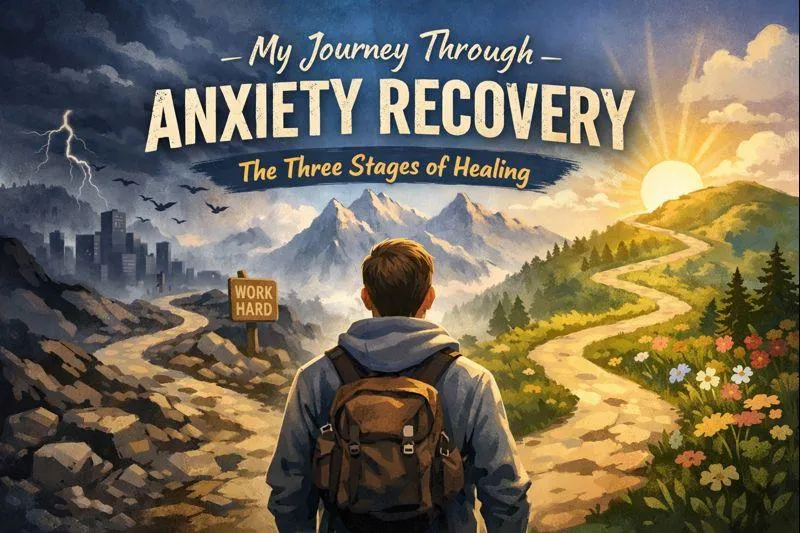
Anxiety Recovery Stages of Recovery
One of the things everyone wants when healing from anxiety and panic disorder is a single breakthrough moment where everything suddenly gets better. I know that’s what I wanted. I just wanted to be healed and to get on with my life again.
But that isn’t the reality.
Healing doesn’t happen overnight. It happens in stages, often messy, confusing, and definitely not in a straight line.
Looking back now, I can clearly see three to four distinct stages I’ve moved through so far. Understanding these stages has taught me to be far more compassionate with myself and less afraid when things feel uncomfortable.
I also want to share that journey so others can learn from it and help with their own recovery. I didn’t have a roadmap to follow and felt so lost at times, so I hope by sharing, others will be able to heal and understand the process.
Stage One: Fear, Confusion, and Losing Your World
The first stage is terrifying.
This is the stage where anxiety and panic appear out of nowhere, and you have no idea what’s happening. Your body starts reacting in ways you don’t understand. Panic attacks escalate. Symptoms multiply. Fear grows. You are suddenly living a nightmare. I often say I wouldn’t wish anxiety on my worst enemy, that’s how horrible it can be. It feels like a slow and torturous death. Your life being stripped away from you without knowing why.
For me, things gradually got worse and worse until my world became very small.
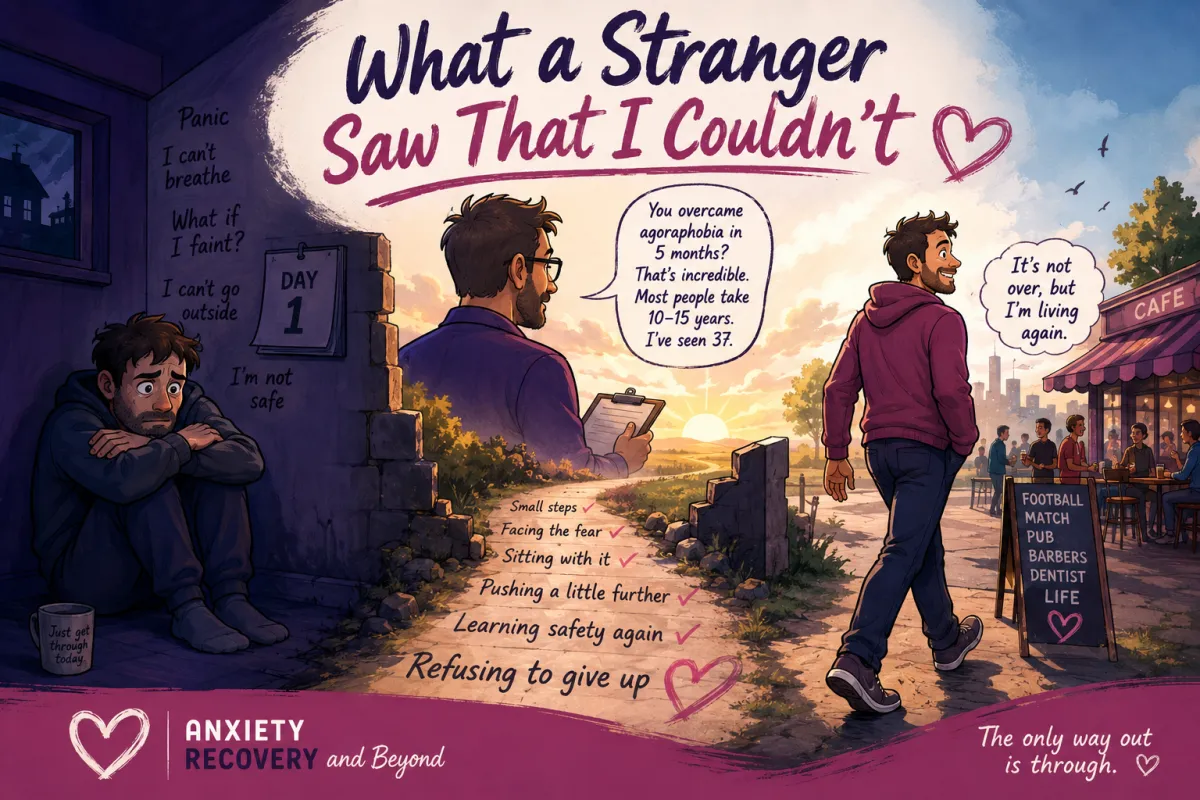
I became agoraphobic and struggled to leave the house. I was housebound for five months. Every sensation felt like a threat. Every symptom felt like proof something was seriously wrong. I was stuck in a panic attack 24/7.
For me, this stage involved a lot of Googling, chats with ChatGPT, and scrolling for hours through Instagram, YouTube, and Facebook posts looking for answers I wasn’t getting from doctors.
You Google everything.
You try to understand what’s wrong with you and why you are feeling the way you are. None of it makes sense. One minute you were fine, the next a nervous wreck, unable to do anything.
You look for reassurance, answers, fixes, cures. I was looking for anyone who could help me and show me a path to recovery.
It’s exhausting. And it’s lonely, and it feels like a battle you are losing every day.
But this stage is important because it’s where awareness begins, even if it doesn’t feel like it.
I feel like I got a degree in anxiety and panic disorder and how to regulate the nervous system from all the research I did trying to find out what was wrong with me and create a recovery plan.
I’d say in this stage my saving grace was my determination to get better. I wanted to find a solution and wouldn’t stop until I found one. I kept repeating to myself that there had to be a way I could reclaim my life. It was hard to believe that at times, and I often didn’t, but every day I would try something to help myself heal.
Stage Two: Doing the Work Without Seeing Results
The second stage is probably the most discouraging.
This is when you start learning what might help: nervous system regulation, breathing exercises, exposure, mindset work, lifestyle changes. You begin putting the tools into practice.
And nothing seems to change.
You still feel anxious.
You still panic.
You still feel broken.
This is the stage where the thought creeps in:
“Maybe this is just how my life is now. I’m going to be stuck like this forever. Maybe it is something else and not just anxiety.”
It’s incredibly hard to keep going here because the effort feels invisible. You’re doing the right things, but your nervous system hasn’t caught up yet. So you wonder if you should be doing something else instead, as it isn’t working.
But here is the trick. If you show up consistently with the regulation techniques, the breathing exercises, and pushing yourself outside your comfort zone, slowly something shifts.
Not dramatically. Not overnight.
You start noticing tiny glimmers of progress:
You can do something you couldn’t do before
Panic attacks don’t last as long
The intensity softens slightly
Recovery after an anxiety episode is a bit quicker
These moments are easy to dismiss, but they matter more than you realise.
To be honest, I struggled with noticing the improvements I was making. Some days I felt like I was improving, but because I was still having panic attacks every day and feeling really anxious, it didn’t feel like progress. So I dismissed it and told myself I was still ill, which I was, just maybe not as bad. Same same but different, as they say in Thailand.
I knew I was able to walk outside again on my own and do some things around the house again, but it didn’t feel like progress because I was still so anxious and having terrible bodily sensations. I was also comparing myself to who I was before anxiety and what I thought I should be able to do, rather than where I had come from at the start of anxiety, and that was a big lesson in my healing journey.
I needed to come to terms with where I was and how far I’d actually come from my lowest point. I had to accept I wasn’t going to get back to conquering the world straight away, and when I learned to accept that, I started to see progress.
Having said that, it still took me a while to see it that way. It was my family telling me they could see me making progress and that I was doing better. I’d often lean on them for reassurance as I felt so hopeless. They would promise me I was making progress and tell me how proud they were of me, but I still struggled to see it because I still felt awful on the whole.
It was only when I started writing a journal and tracking my recovery that I started to believe it myself. I would score my daily anxiety out of 10 and give myself a smiley or sad face for the overall feeling of the day. At first, my scores were 10 and I had red faces every day. But gradually, over time, I started to see more green faces and my general anxiety scores were coming down to 6s and 7s.
Now I can go long periods at home without having anxiety, but it will still appear throughout the day or if I go out to do something, so the scores are generally 3s and 4s. There is still a little way to go to full recovery, but this is huge progress.

Stage Three: Rebuilding Confidence and Learning the Balance
The third stage is where things start to get interesting and challenging in a very different way.
This is the stage where some confidence begins to return.
You start pushing yourself again.
You begin testing your limits. In my case, I often pushed too hard for too long.
You prove to yourself that you can do things again that you once believed were impossible and that you’d never do again. Things that felt completely out of reach not long ago slowly came back into my life.
But with that comes more anxiety and panic.
Not because you’re failing, but because your nervous system is still sensitive. Every push creates activation. Every challenge triggers fear, or physical sensations that create fear. Your body is relearning safety, and it doesn’t trust the world just yet.
It took a lot of willpower in this stage to pluck up the courage to face things. You know you are going to feel awful doing them, you know it will exhaust you, and you most likely won’t enjoy it in the moment, but you know you have to push yourself through that discomfort to start healing.
This stage was all about pushing through mentally and picking yourself up after each push when feeling exhausted and like you had a body still working against you. This stage would probably have been easier to back away from and stay in my comfort zone, but as I always say, the only way out is through. Don’t back away. Keep moving forward.
This stage taught me a lot.
It taught me that you can push, and through that push will come panic and anxiety, but you can push through that panic and come out the other side. However, on the other side, you need to give yourself time to come down and regulate.
I had to learn:
When to challenge myself
When to allow recovery time
How to regulate my body after stress
How to apply the tools consistently, not perfectly
Progress at this stage isn’t about eliminating anxiety.
It’s about building trust with your body again and allowing it the time to regulate.
Pushing Hard
I went through a period where I pushed myself to my limits mentally and physically. I was fed up with not living my life, so I put myself into intense situations, overloaded my body with stress, and lived in a near constant state of adrenaline.
For five weeks, I pushed myself every day to play full out and do all the things I wanted to do. I was doing things I had done in the past pre anxiety, and I was living again. But it did come at a cost, having panic attacks again every day. But each panic attack taught me something.
I was doing things that I knew what they should feel like. Some things I knew created natural nervousness, the butterflies you get on a first date, waiting to go on stage at a school play, or the sense of anticipation before an extreme sport. Experiencing that on top of panic was a big learning step for me.
It felt like I had a superpower because I could feel the normal sense of nervousness and the anxiety and panic on top. I realised it was just an extremely intense version of the same thing. It also taught me that there was a wave to panic, and if you can ride that wave, you can get over the top of it and come down the other side. The more you do that, the more the body learns to calm down quicker.
Every day I was pushing myself, I was having panic attacks and felt like I was breaking down. But every day I had a panic attack, I came out the other side feeling like I was winning. This was different in that I was almost expecting the panic attacks to happen. They weren’t just happening when I was doing nothing like at the start. These were because I was pushing myself out of my comfort zone, almost inviting the panic to come on.
Expecting the panic and almost inviting it helped me get through them. It was like saying, you can’t hurt me. I’m going to do this anyway. You can make me feel like crap, but so what. I think this took some of the power and intensity away from them.
What I found was that the panic attacks weren’t lasting as long and I was functioning after them. Before, when I had a panic attack, they could last for hours or even days. It felt like I was trapped in a constant state of panic, and the comedown after could last a few days as my body tried to recover.
Now they were lasting 10 to 20 minutes and I was able to recognise what was happening in my body. I knew I was going to feel wobbly and light headed, and then I would get a wave of energy wash over me. Knowing that, I almost egged it on, daring it to try and hurt me. That thought process changed the dynamic with panic.
In this stage, I also started to learn the other side of panic, the comedown and regulation of the body. I could feel the adrenaline surge leaving my body and the effects that had on it. Whereas before, the comedown would scare me because of all the sensations in the body. You can literally feel everything. It would retrigger panic and anxiety and I wouldn’t do anything. I’d try and run from the symptoms.
But now I knew what symptoms to expect and I would talk myself through them whilst engaging in life. So instead of sitting in the panic, I would go outside and walk or try and engage in conversation, do something active. Not ignoring the symptoms, just accepting they had to do what they needed to do in the body.
But this stage also taught me that healing isn’t about pushing endlessly. By pushing continuously, I was wearing myself down physically, as constant adrenaline and panic are exhausting. Being in that heightened state probably brought on more panic than it needed to. If I’d given myself more rest time in between, my nervous system would have had more time to regulate.
So even though I taught myself I could push through it and face panic and anxiety head on, I needed to learn how far to push and when to rest and pull back.
This stage was another big lesson.
It showed me two very important things.
Mentally, I could still do hard things.
I could face panic head on, go through it, and come out the other side. The panic didn’t destroy me. Yes, it was uncomfortable and I wouldn’t choose to feel that way, but it was no longer going to stop me living life.
My body still needed time to recover and heal.
Living in constant activation came at a cost. I’d proved I could do it, now I needed to learn to relax and calm down.
At the time, it felt like strange progress.
I was living again in spite of panic.
I was doing the things I loved again while having panic attacks. I wasn’t healed, but I was living again.
That’s a weird kind of progress. But it’s still progress.
However, I eventually realised I was stuck in a heightened state of adrenaline and fear. I mistook constant exposure and constant pushing for healing, when what my body actually needed was regulation.
I needed to slow down again.
I needed to let my nervous system come back to a baseline.
I needed to recover between the challenges and constant pushing.
Another thing I noticed in this stage was that my mind was coming back to being mine. For so long, all I could think about was anxiety and noticing anxious feelings in my body. I was sensitised to the tenth degree and couldn’t focus on anything else.
But now I was starting to engage with life again. My mind started thinking about what I wanted from life again. I started to have goals and aspirations again. I was coming out of constant survival mode.
Where I Am Now
Healing hasn’t been a straight line.
There have been setbacks, plateaus, and there are still hard days.
But I’m no longer lost in the darkness of not knowing what’s happening. I’m no longer convinced I’ll never improve and heal. And I’m no longer afraid of every sensation in my body, just occasionally. I’m still having panic attacks, but they are less intense. I still have waves of anxiety throughout the day, which sometimes get the better of me, but they are no longer all consuming.
I can function through it now, and once the wave of anxiety passes, I feel more like myself and capable. I’d say I’m still managing anxiety, but it’s manageable.
My hope is that in the next stage, I will no longer be managing anxiety. It will be a thing of the past, and I will be fully functioning again. I don’t know how long that will take, but I will continue doing the things I have been doing to help me recover.
If you’re going through anxiety and feeling lost and not making progress, know this.
You are not broken
You are not failing
You are not behind
You’re just moving through a stage.
Healing takes time, but it does happen. The key to healing is finding consistency with the healing activities that help you over time, not instantly. If you can do that, your body will learn to regulate itself again. It’s about knowing when to push but also when to pull back. You have to push through the fear and discomfort to come out the other side, but you also need to allow the body and nervous system to calm down too.
You are retraining your nervous system to find balance, and that takes time. Be easy on yourself. Don’t beat yourself up for feeling the way you do. Allow it, give thanks to it, and give yourself time to heal.






Mail
Facebook
LinkedIn
X
Pinterest
Snapchat
Reddit